

.png)
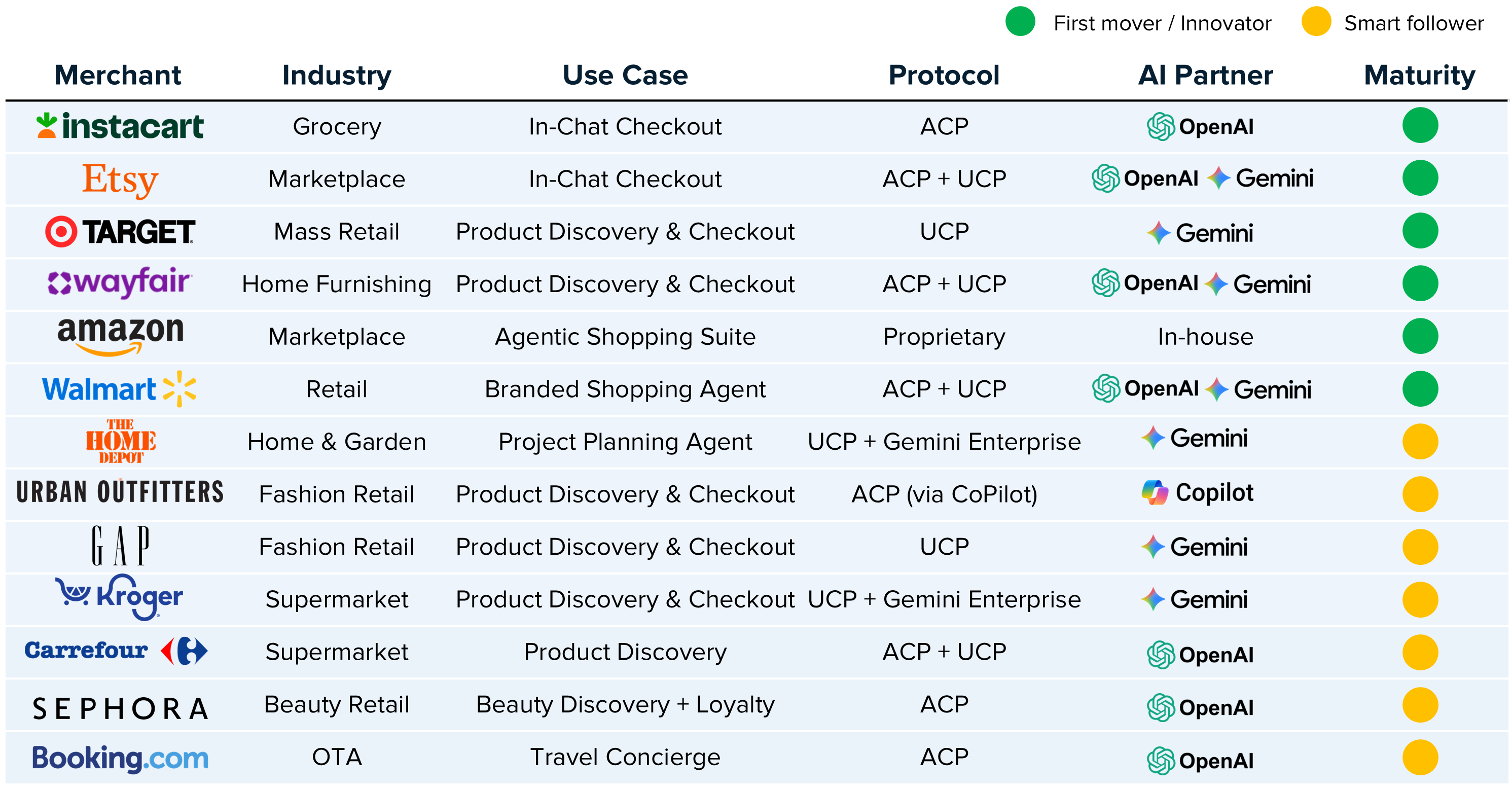
Agentic commerce is moving from concept to concrete infrastructural developments. In our previous publication, we outlined The Rise of Agentic Commerce: How AI will Reshape Merchant Strategy. The developments in this space are accelerating as real-world use cases emerge across verticals (figure 1). The emerging pattern is not single protocol adoption, but protocol pluralism: leading merchants are experimenting across popular protocols (ACP, UCP), proprietary agents, and AI platform partnerships. This challenges the assumption that protocol ownership alone would hold the key to success. The future of commerce will not be shaped by protocol authorship, but the ability to combine customer ownership, merchant trust, operational breadth and trusted payment execution.
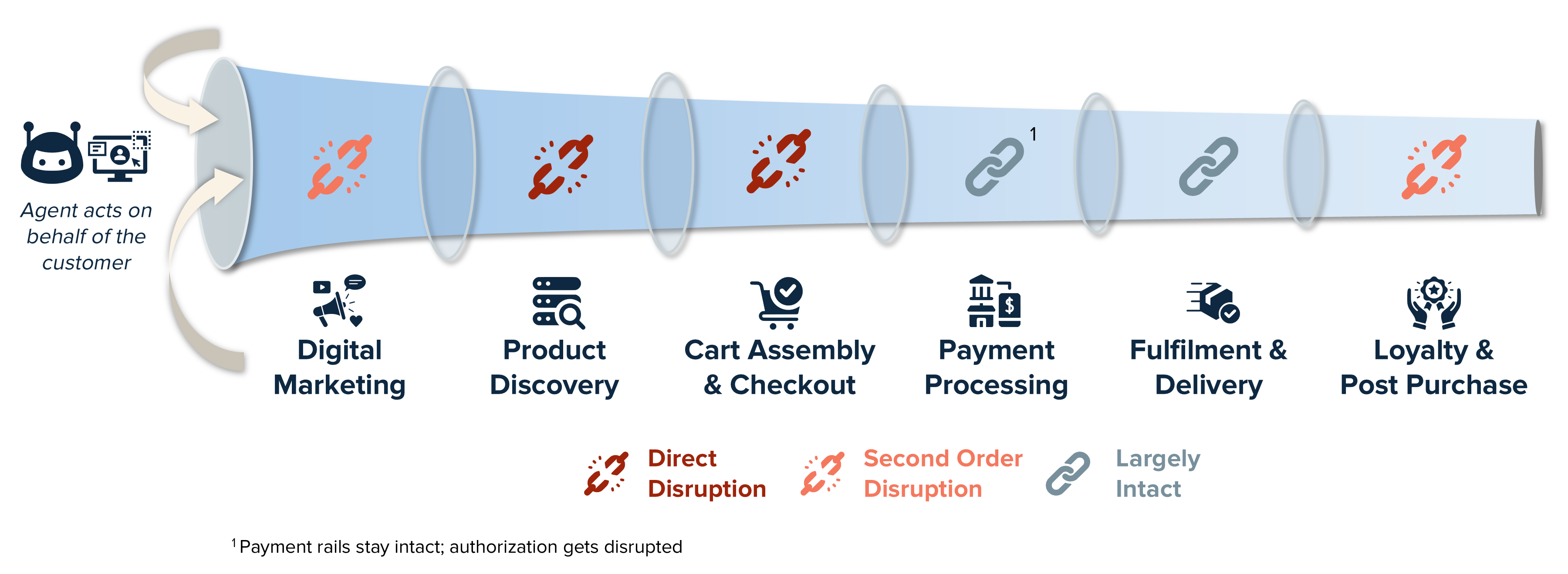
The last decade of e-commerce innovation concentrated almost entirely on one problem: removing friction from checkout. We moved from clunky, multi-page checkouts to one-click accelerated checkout, tokenised cards and biometric authentication. Counterintuitively, agentic commerce removes friction not from the checkout, but from product discovery and cart assembly, and that in turn has second-order effects breaking customer loyalty, ownership and digital marketing (figure 2).
Agentic commerce is not an incremental improvement; it is a disruptive one that breaks many of the existing systems rather than optimising within them. This is expected to trigger a significant rearrangement of the provider landscape, prompting incumbents to develop new solutions aimed at preserving their relevance and capturing control points in the agentic commerce ecosystem. But history offers a useful parallel: many of the winners in the brick-and-mortar era did not go on to dominate e-commerce. Similarly, today’s e-commerce leaders may not retain pole position in agentic commerce without facing meaningful competition from AI-native challengers.
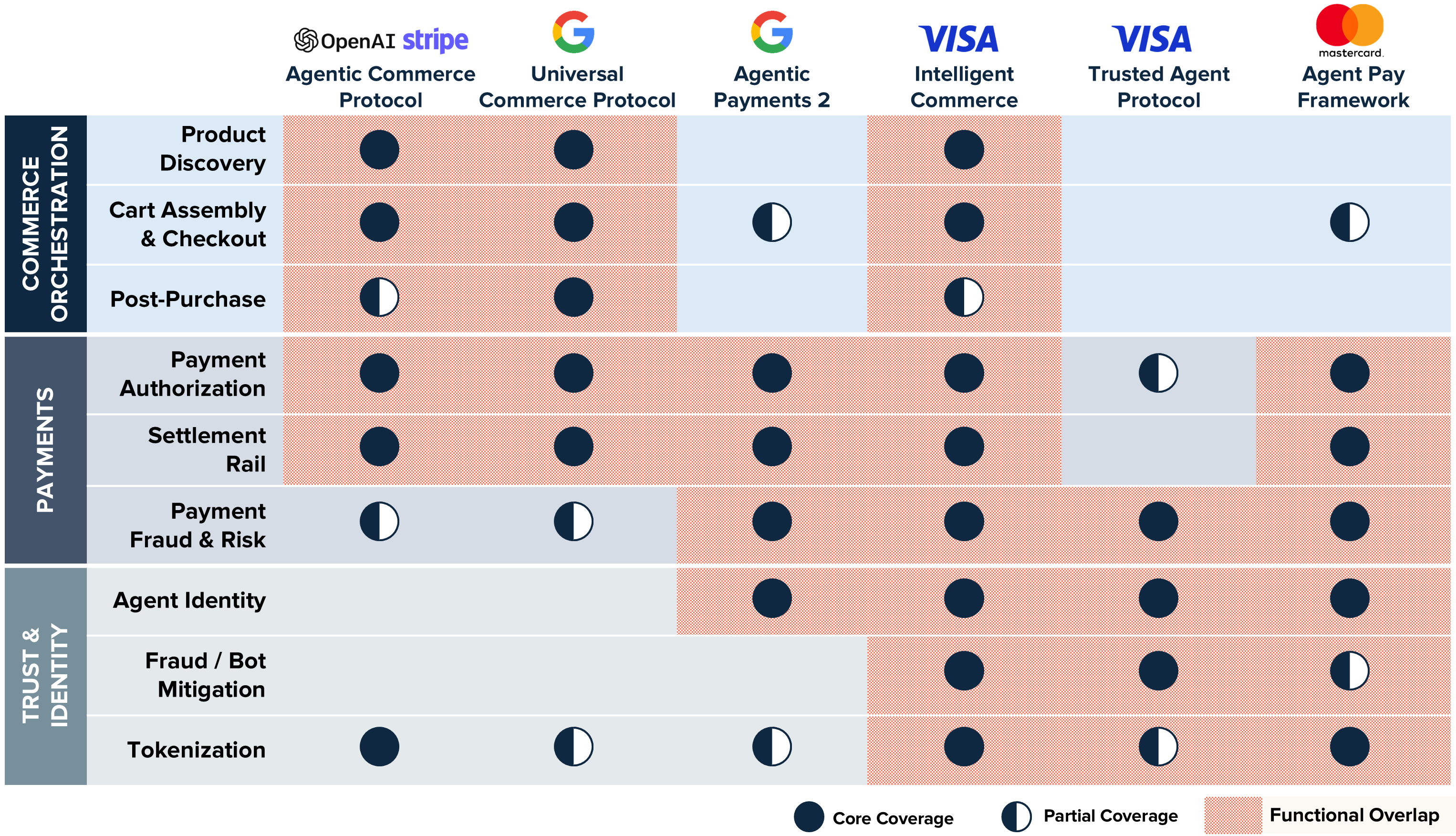
In the last year, there have been a number of protocols launched by card schemes, PSPs and most interestingly, big tech. Many of these protocols are competing instead of complementing, inhibiting the acceleration of agentic adoption and creating confusion for merchants. Figure 3 shows that many of the protocols are working to establish the rules of the same game. Stripe & OpenAI’s ACP and Google’s UCP largely overlap in commerce orchestration, while Visa’s TAP, Mastercard’s Agent Pay and Google’s AP2 focus on agent identification, intent verification, and secure payment authorisation. Visa’s ICC arguably represents the most comprehensive protocol suite, bundling TAP’s trust framework with full payment infrastructure and commerce orchestration.
The result is not simply a standards race. It is a battle for control points across the agentic commerce stack: where the consumer begins the journey, where the merchant retains control, where payments are authorised, and where post-purchase data is captured. This shifts competition away from isolated payments, checkout, or catalog tools and toward full-stack orchestration.
Noticeably, leading schemes, PSPs and tech companies are extending their footprint across the value chain in an effort to retain control in the new ecosystem. While some are defensive, others are putting an offensive foot forward. In the agentic commerce ecosystem, these five factors will determine who controls the most valuable orchestration points:
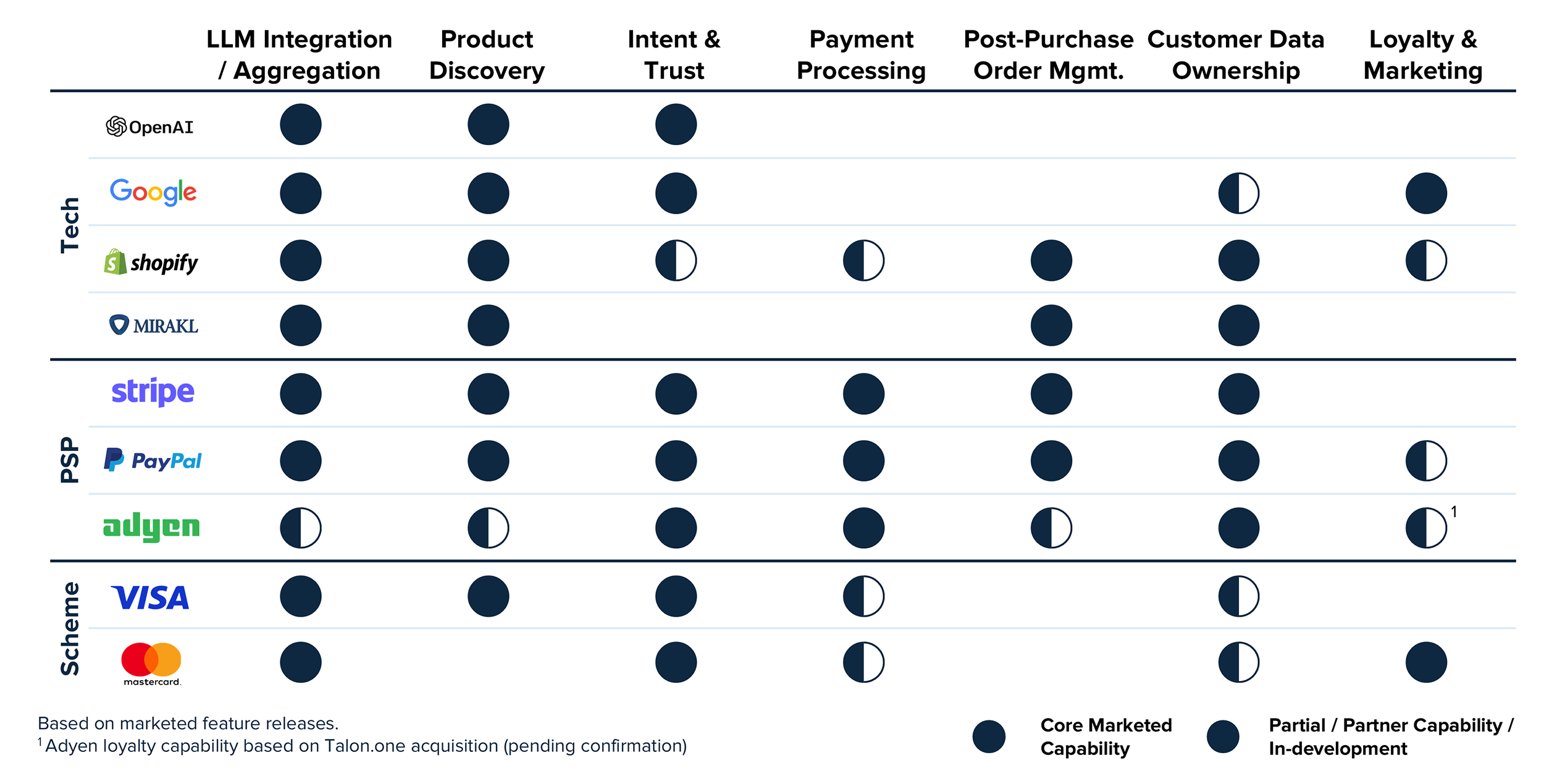
One of the critical battles in the agentic arena will be coverage of services. As merchants move to future-proof their tech stacks, they are expected to avoid the complexity of managing multiple vendors. The success of Adyen’s unified commerce solution has demonstrated that even enterprise merchants are willing to pay the premium for a modern and unified tech stack to optimise conversion and unlock omnichannel customer experience. As shown in Figure 4, PSPs are better positioned to offer the whole suite of services as payment processing remains the one capability requiring regulatory licensing, creating a natural moat for PSPs that tech platforms and schemes cannot easily cross.
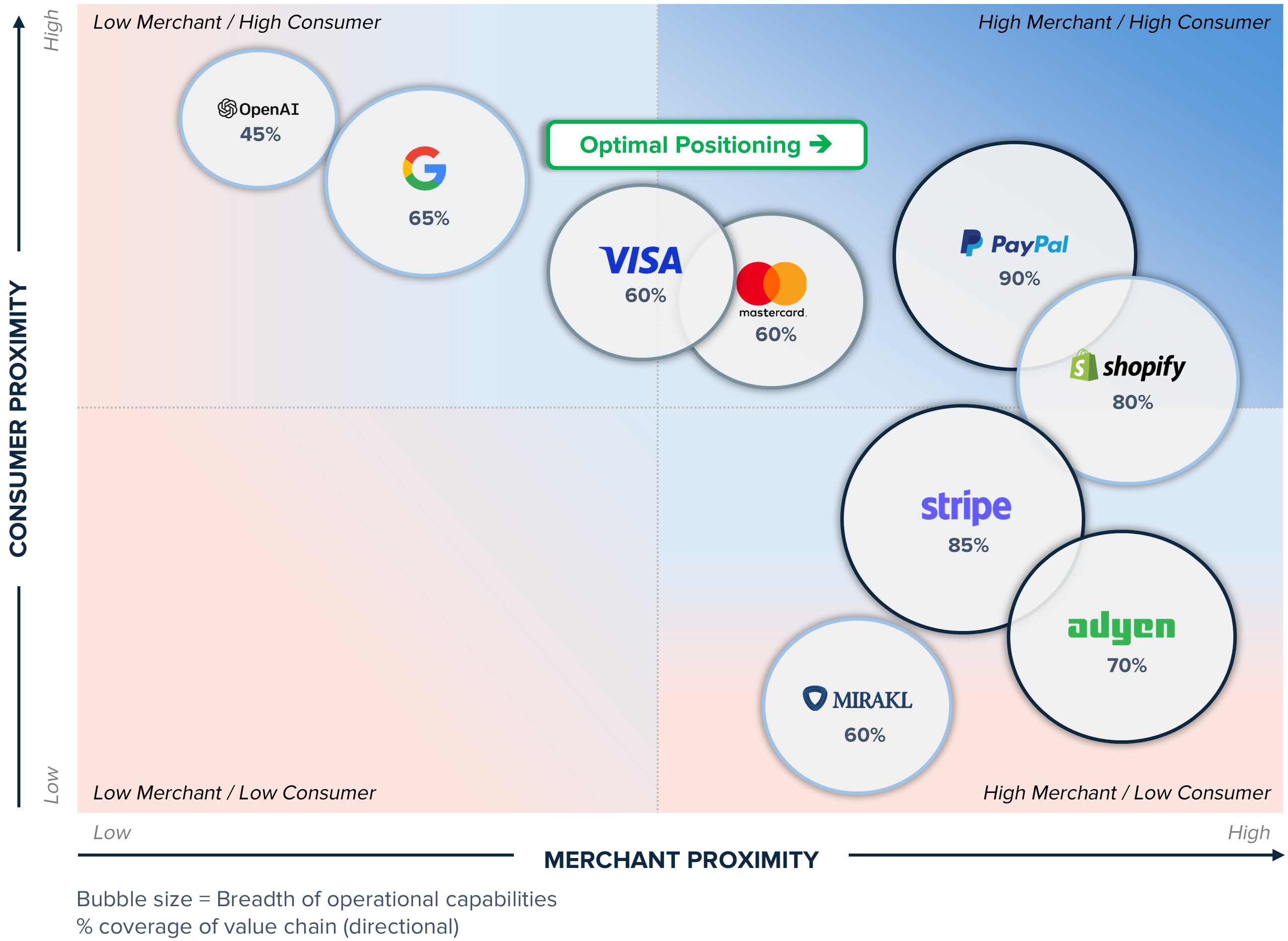
Although a critical piece, coverage of services is not the only factor here, as mentioned above. Figure 5 evaluates the leading players in terms of merchant and consumer proximity with an overlay of operational capabilities. PayPal, Shopify and the schemes emerge as strong contenders with a high merchant and consumer proximity while OpenAI and Google are the closest to the consumer, potentially influencing shopping entry points and customer data ownership. Global PSPs such as Stripe and Adyen possess a competitive advantage across the last two winning criteria as they remain deeply embedded in the merchant’s current tech stack and own the relationship to influence decisions and offer global scalability.
The future of commerce orchestration may unfold in three primary scenarios. (figure 6). If the consolidation persists and merchants experience strong lock-in and high switching costs, the provider battle may result in a winner-takes-all situation. If the agentic ecosystem mirrors how the internet evolved, protocol federation becomes the path ahead. No single player controls the orchestration role; instead, open standards become the connective tissue of the ecosystem.
The most probable outcome is vertical and regional fragmentation. Multiple winners emerge across verticals and geographies rather than a single global winner. In travel, GDS-adjacent players dominate agentic booking. In B2B commerce, ERP-integrated agents (SAP, Oracle) control procurement flows. In SMB retail, Shopify's catalogue and checkout depth gives it the edge. In enterprise retail, Adyen's deep enterprise integrations and unified commerce infrastructure give it a structural advantage in enterprise retail. In markets with strong local payment infrastructure (India, Brazil, Southeast Asia), domestic players retain control.
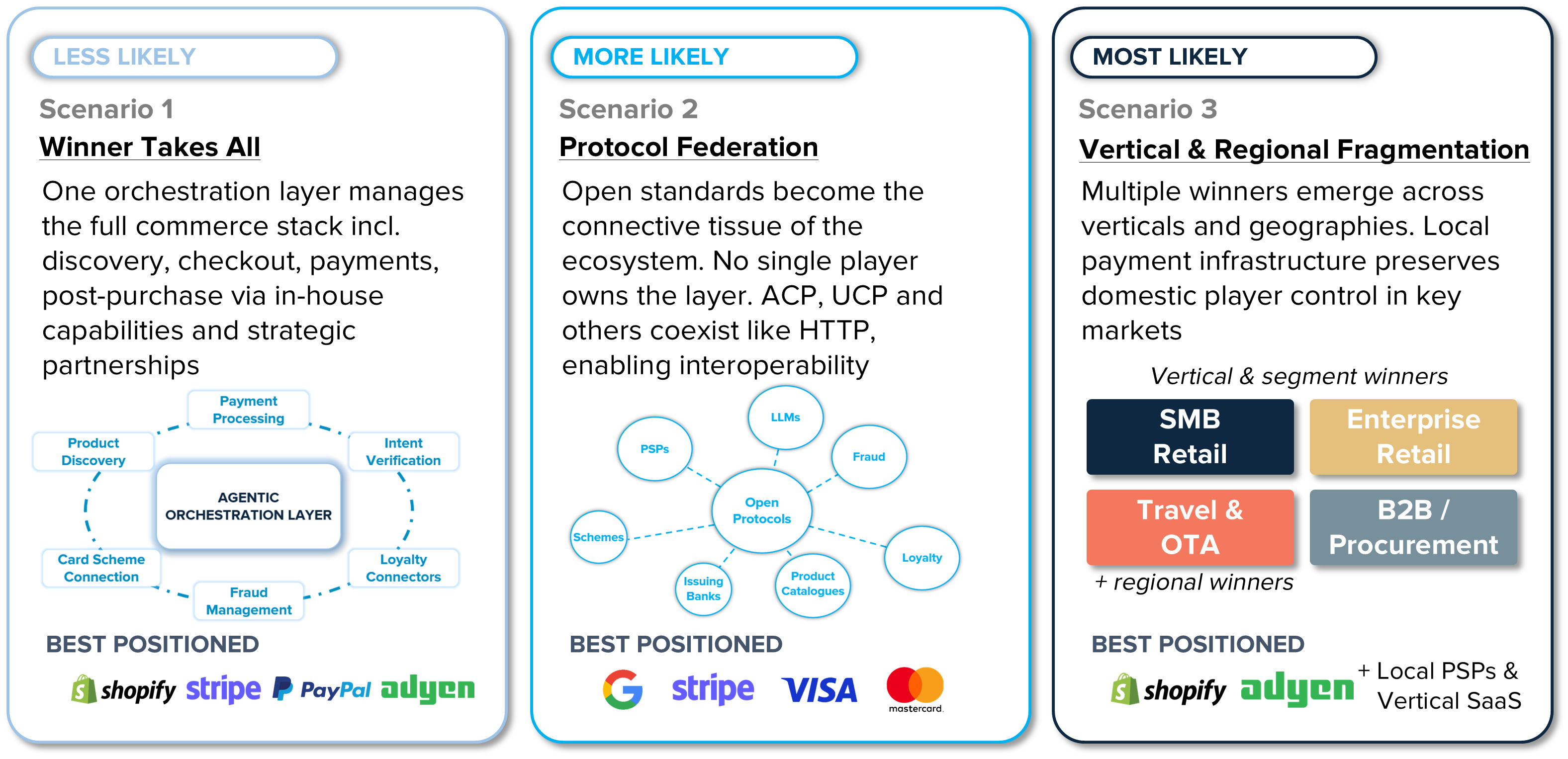
The future of agentic commerce will not be controlled simply by whoever writes the protocol. It will be shaped by the players that can orchestrate consumer intent, merchant control, operational integration, and trusted payment execution. Under the most likely scenario of vertical fragmentation, no single player holds the key universally. But the providers who combine merchant trust with broad service coverage are best positioned to define the winners within each vertical.
Get in touch with our team to learn more about the impacts of Agentic Commerce on your business and how to prepare for an agentic future. Reach out for any comments or questions.
.png)
Get in touch with our team to learn more about the impacts of Agentic Commerce on your business and how to prepare for an agentic future. Reach out for any comments or questions.

.png)
.png)