Commerce is on the verge of a full circle moment. In the pre-internet era, buyers and sellers engaged in open market negotiations. Today, those exchanges are implicitly shaped by design, user experience, brand perception, and ease of checkout; subtle forces influencing every purchase decision. Commerce began from human-to-human and evolved into human-to-machine interactions with the introduction of e-commerce. The rise of AI agents marks the next major inflection point as we move towards an even more sophisticated selling environment. AI agents interact on behalf of shoppers, engaging with thousands of stores and catalogues in a matter of seconds to find the best deal, bringing unprecedented speed and convenience to the consumer. On the other hand, merchants face the risk of losing brand loyalty, proximity to customers, or worse, seeing their products and services reduced to commodities in the sea of AI-driven recommendations. In this article we will review the latest developments in agentic commerce from a merchant perspective. We will compare user journeys, potential challenges, implementation models and value creation opportunities.
Update: the protocol landscape has moved quickly since this article was published. For our latest analysis of ACP, UCP, Agent Pay, AP2 and Visa ICC, read Who holds the key to the future of commerce orchestration?

Whether Agentic commerce will help unlock a new and powerful acquisition channel for merchants, boosting sales or end up cannibalising them relies on intricate technical underpinnings, including API endpoints, data pipelines, and cross-platform connectors that determine how agents access and transact with merchant inventories. Nonetheless, it is certain that the customer journeys will be radically compressed compared to traditional e-commerce (see Figure 1). There are some key differences between human and machine behaviours that will impact buying journeys and consequently conversions:
According to McKinsey research, US B2C retail market alone could see up to $1 trillion in revenue from agentic commerce by 2030, with global projections estimated between $3 and $5 trillion. The impact of agentic commerce is expected to be similar to the web and mobile commerce revolutions, but there are a range of challenges pertaining to its enablement and merchant inclusion given the current e-commerce infrastructure.
Some of the key challenges yet to be navigated to ensure a smooth agentic commerce ecosystem:
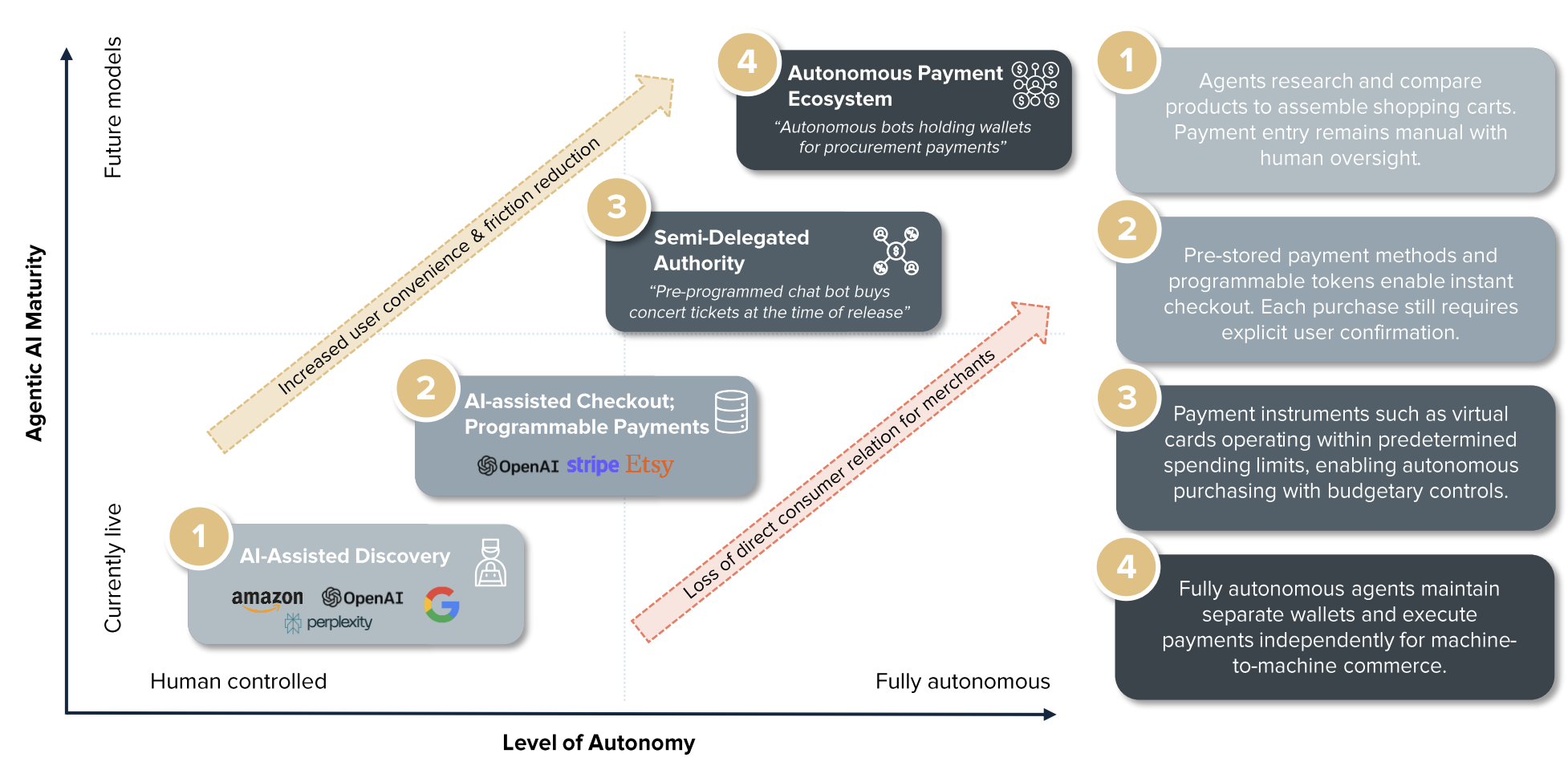
Agentic commerce remains in its nascent state with various operating models emerging. Currently most protocols enable a live product search and real-time user authentication for payments in an ‘assisted checkout’ mode. Future use cases will allow for fully delegated and autonomous transaction authentication with verified user consent (see figure 2). In a fully autonomous payment ecosystem, the shopping agent executes transactions under a digitally signed authorisation that specifies parameters such as budget, timing, and payment methods enabling secure, human-out-of-the-loop commerce.
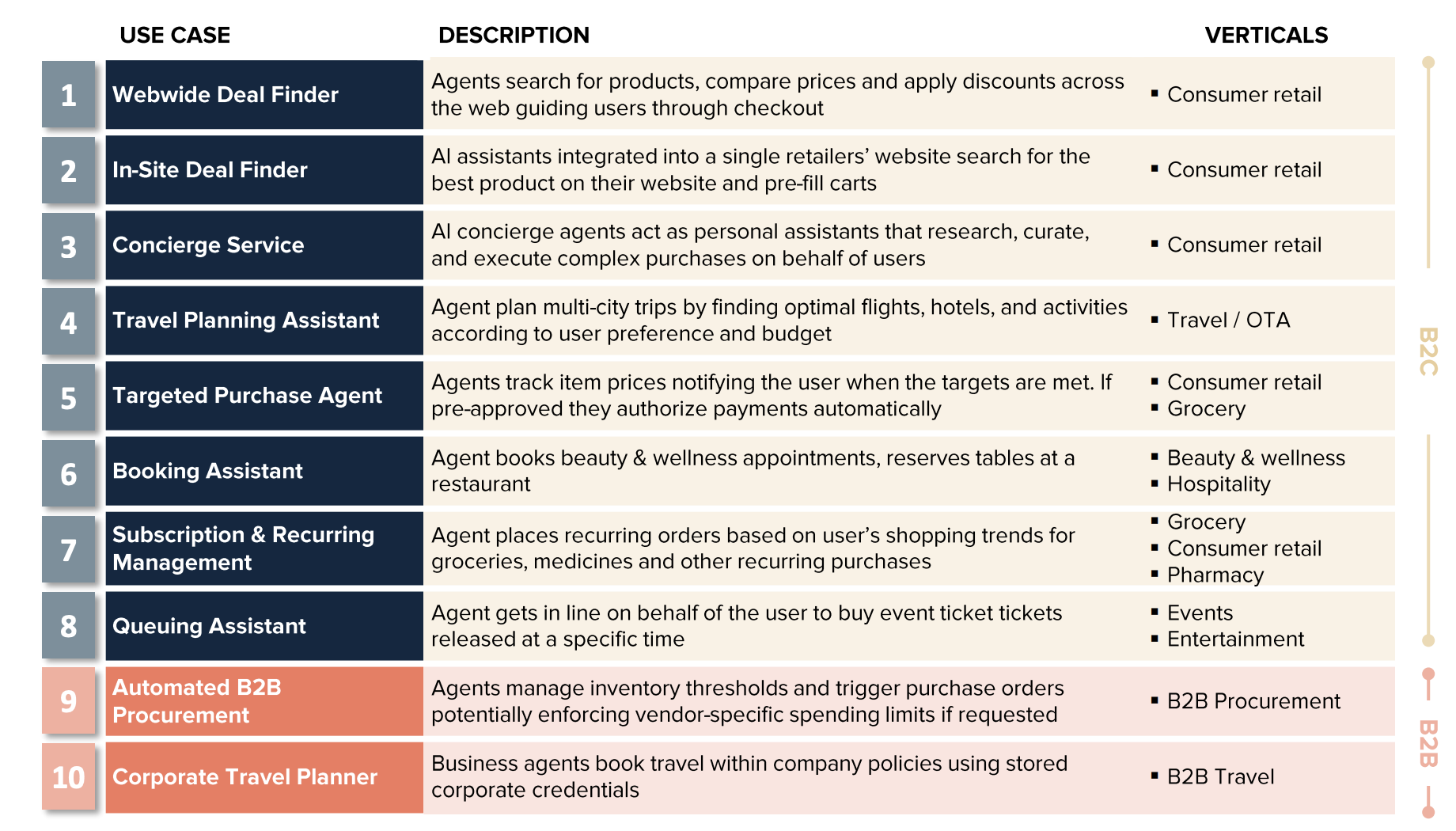
Embedded payment functionality in AI chatbots is transforming digital transactions. This is most visible through seamlessly integrating secure payment flows into AI chatbots. Consumers can leverage AI agents for a range of use cases. The most common use case today is product and deal discovery by aggregating pricing data across multiple websites or within a single merchant’s catalogue, pre-populating shopping carts and then awaiting manual authorisation to complete checkout. But agentic commerce has a diverse and wider list of use cases. Some of the most emblematic use cases include concierge services for shoppers, complex multi-city travel bookings, or acting as a targeted purchase assistant with pre-defined parameters (see Figure 3). In corporate environments, procurement agents may enforce spending policies by using virtual cards with predefined limits. They then automatically trigger purchase orders once inventory thresholds are reached, processing invoice payments instantly against approved budgets.
Various ecosystem players, including big tech, AI firms, PSPs and card schemes, are rushing to create protocols and adapt the current infrastructure to cater to agentic commerce facilitation. The different protocols may cause confusion amongst merchants regarding the use case and relevance, but most of them are solving different problems along the agentic commerce value chain. While Mastercard’s Agent Pay and OpenAI and Stripe’s Agentic Commerce Protocol (ACP) create programmable tokens to facilitate transactions, Google’s Agent Payments Protocol (AP2) creates cryptographic digital signatures to help merchants verify user intent. Visa’s Trusted Agent Protocol addresses a critical problem of distinguishing between a legitimate AI agent vs. malicious bots using cryptographic signatures. We break down some of the main protocols announced in 2025 below in Figure 4.

At a high level, there are 3 main implementation models that merchants will adopt to enable agentic commerce. The first, and the most common one for merchants that have limited operational capacity and resource constraints, would be to use light adapters and hook into current gateways. The other 2 options are more complex and agent-based and require a dedicated agentic commerce strategy, either using a hybrid approach separating the agent traffic and protecting the existing human traffic. The last one entails fully offloading the agentic traffic by creating new catalogues, agent specific landing pods to optimise engagement and conversions.
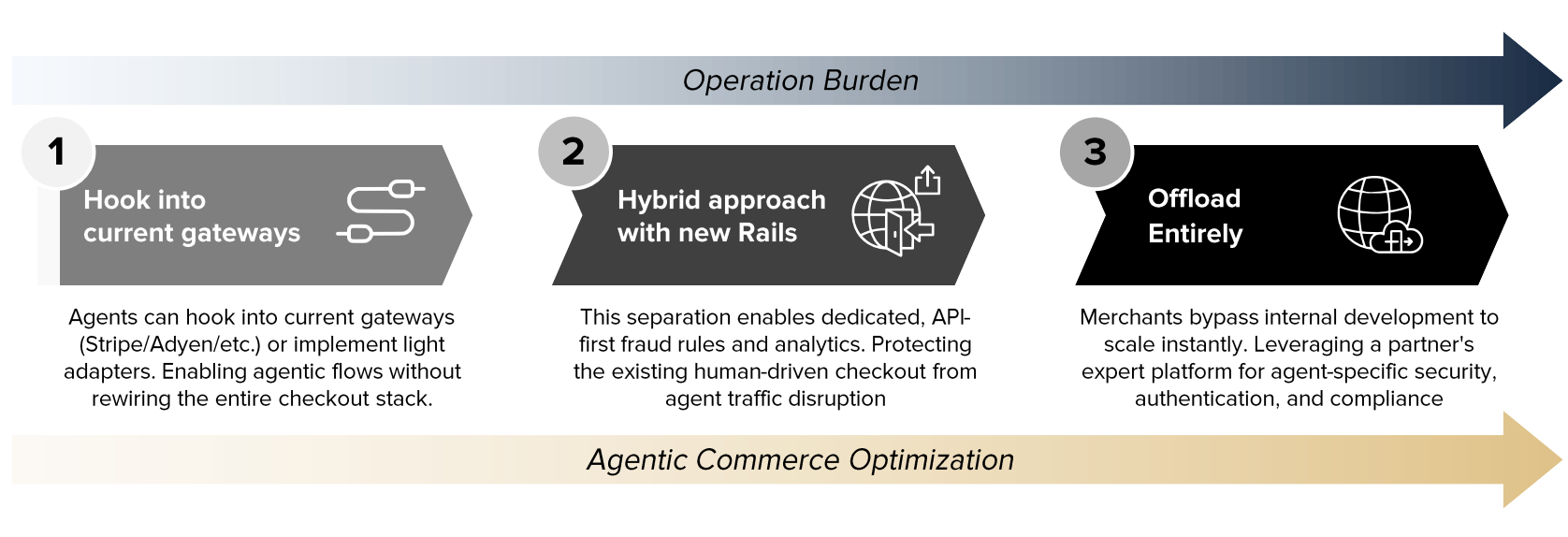
While enabling agentic commerce may be a defensive move for most merchants, the ones that can facilitate this transition quicker and position themselves as not just enablers, but leaders of the change stand to gain a competitive advantage. There is a range of strategies merchants can leverage based on their size, risk appetite and current e-commerce infrastructure:
We are still in the primitive stages of the agentic commerce revolution, we will be following and reporting on the latest developments in this space. If you are a merchant looking to optimise your product strategy for agentic commerce or a PSP struggling to stay on top of market developments, feel free to reach out to us.
Since publishing this article, we have continued to track the space: see our analysis of commerce orchestration, our conversation with Nile on product context, and our meetup with Adyen.




.png)
.png)