Embedded payments have been the flavour of the year for several years now. Originally conceived as bespoke solutions for some of the largest marketplaces or complex platforms, they are increasingly presented to the wider market as frictionless, value-adding, and revenue-driving - a sort of no-brainer for a medium to large platform, or a SaaS/ ISV player. But for many ISVs, platforms, and merchants, the journey is much more complicated.

While success stories, such as Shopify, Uber and Toast drive much of the market interest in this sector, there is a growing number of quiet failures, slow and eventually delayed rollouts and even strategic retreats. You don’t notice these until you come across a Saas website that has somehow left ‘Powered by >>insert PSP name here<< ‘ in their T&Cs, only to realise that the feature launched a year ago has quietly disappeared.
We should take note since launching an embedded payments programme is, for most companies, not a trivial task – but one that requires significant attention from the leadership, management resources and financial investment.
Far from wanting to discourage you, my objective here is to explore the ‘dark side’ of embedding payments to help leaders avoid the common traps.
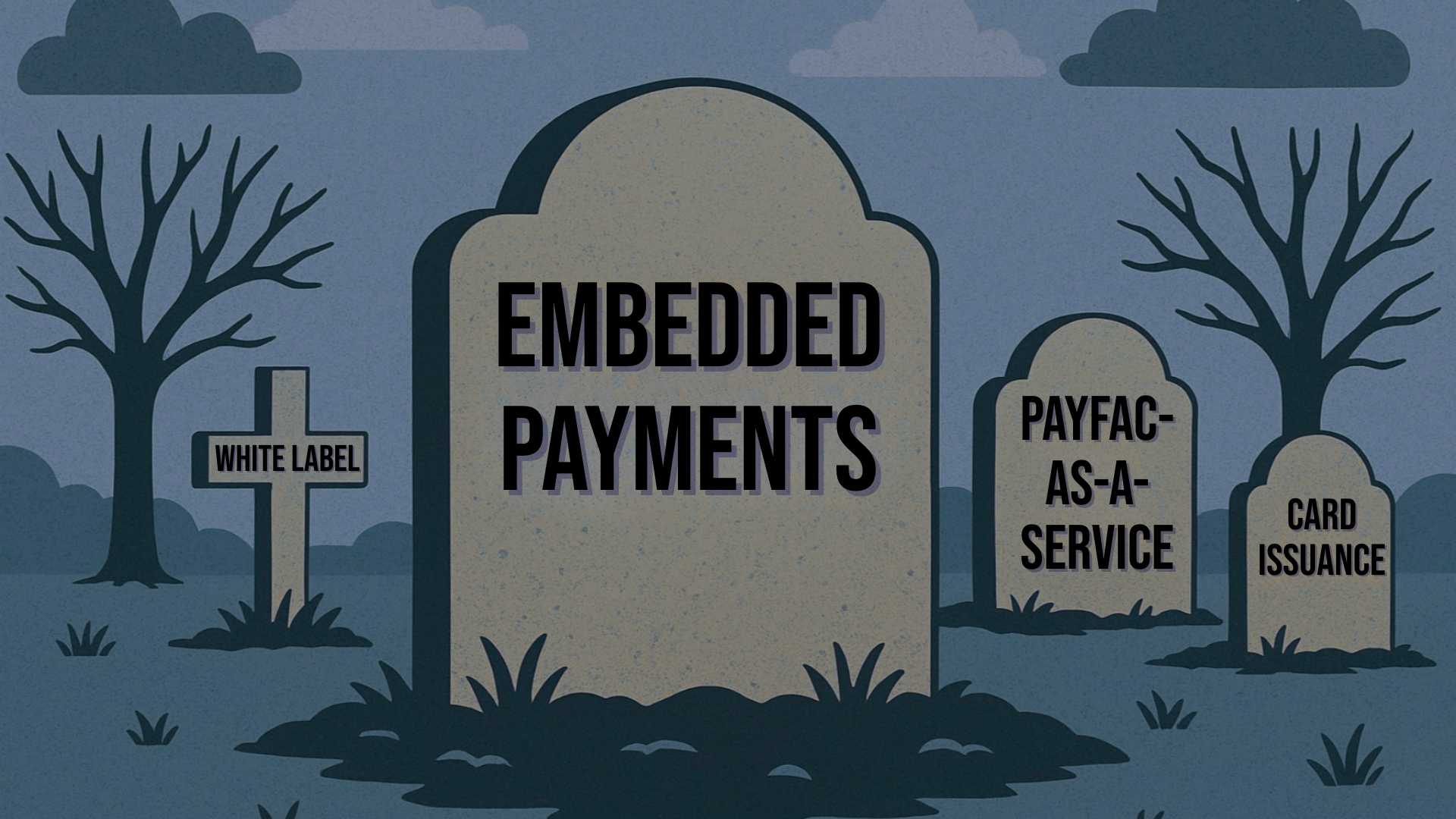
We have all been guilty of it at some point: focusing on showcasing the financial upside of embedding payments. And indeed, it can be significant. But too often, business cases rely on overly optimistic assumptions about adoption rates and margins.
In practice, the cost of supporting payments- especially for a company that is new to the space - can erode the upside. Margins can easily thin out while payment volumes ramp up slowly since payment behaviour is relatively hard to shift.
In other words, that 40-50bps for payment acceptance looks shinny until chargebacks, FX, slow adoption and reconciliation costs swallow it.
Suppose a leading European vertical SaaS processes €500 million in annual gross volume and expects to capture 70% of it through its own embedded payments flow within three years. With a net margin of 40 bps, the initiative looks set to generate roughly €1.4 million in annual profit, equivalent to an NPV of around €5 to 6 million over five years.
Now imagine the typical reality: the rollout takes two extra years, adoption reaches only 50% of volumes, and operational costs thin margins to 25 bps. Under those assumptions, the NPV drops to barely €2 million - a 65% decline.
What looked like a strategic revenue engine quickly turns into a capital-intensive side business with limited upside.
Similarly returns on issuing credit cards can be high – but so is the cost of keeping a large number of credit lines open while most customers are not using them. In Europe, where the use of credit cards is much lower than in the US while interchange on consumer cards remains capped, this is a tough proposition to launch well.
Many leadership teams underestimate geographical differences – particularly in Europe. What works in one country doesn't work in others. What makes money on carded transactions doesn’t make money in iDeal.
PSPs and issuers know this. They are often happy to offer attractive headline pricing to new entrants, knowing that if volumes disappoint, they will recoup it through volume-commitment fees. And this can easily sour the relationship, and ultimately low margins often kill embedded payments projects.
Part of the issue is of course underestimating the complexity of launching and maintaining an embedded payment solution. You don’t just ‘turn on’ payments – you need to consider PCI, KYC/KYB, AML, safeguarding rules and card scheme compliance. Partners can handle this, but at a cost - which eats into your margins. Many partners will push full program compliance to you even though you may not be a regulated entity.
Regulatory scrutiny is also growing. Under PSD3/PSR, actors that blur the line between their own role and that of the licensed PSP - for example by not clearly disclosing the underlying provider to sub-merchants - may increasingly fall within licensing requirements, on top of the current rules where this depends on the exact division of activities between the parties.
And this is before we even consider the increased operational load coming from declined transactions, refunds, disputes as well as the added complexity for treasury functions. No team is fully ready for this on day one - and transitions are almost never completely smooth.
The truly awful combination is when the high operational burden meets significantly lower adoption. It is not uncommon to hear from a business (or its PE owner): “Our competitor integrated payments, so we should too. Clearly, if it makes sense for them, it will make sense for us.”
But why would your customers adopt it? How do they get paid today? What do they pay for it? Where is the friction - price, missed payments, delays? Many companies lack clarity on this, which ultimately leads to low uptake – particularly if it is a ‘me too’ offering.
Even well-resourced brands can stumble. In 2023, Swiss retail giant Coop launched Finance+ - a super-app combining banking, payments, and pension services via a network of partners including Hypothekarbank Lenzburg, Vanguard, and additiv. Despite millions of loyal customers, the initiative struggled to gain traction. Coop cited “lower-than-expected demand” and a “changed competitive environment” as reasons for winding it down less than a year after launch.
The underlying issue was not technology, but fit and follow-through. Coop entered an already crowded neo-banking market, relying on multiple embedded-finance partners and ambitious uptake targets. When customer adoption lagged and costs mounted, the strategic case unravelled quickly.
UX can make or break adoption - and is often treated as an afterthought. Payment UI is bolted on when companies prioritise speed to market over API flexibility, fraud tooling, or checkout optimisation.
But customers notice friction immediately, and the promise of a seamless experience is broken – ultimately damaging your brand and the trust that customers place in you. This is particularly true about clunky refund processes which can erode trust quickly. Embedding payments should mean reusing existing (known) data as much as possible to reduce potential friction and the burden on the user.
Finally, many failed embedded payments projects are doomed from the start because of the inadequate setup that isn’t aligned with the strategic direction and requirements of the company launching a payments product to their customers.
There are many different models that platforms, ISVs or Saas companies can utilize to launch payments – from referral models to a fully-fledged Payfac through hybrid options which are increasingly enabled by leading PSPs, modern acquirers and orchestrators. Each represents a different balance of control, regulatory exposure, compliance burden, and operational complexity – resulting in often significant margin differences.
Too often this is decided based on solely short-term considerations – leading to a loss of control, poor margins and uptake. This is particularly true when companies want to limit their initial investment and ‘test’ the commercial potential of embedding payments through a ‘quick and easy’ integration that isn’t fully integrated into their core proposition and user experience.
Choosing the right partner is equally important as underneath seemingly interchangeable language around global coverage, pricing and capabilities, there are significant variations in execution and focus which ultimately translate into the right or wrong fit for partnership.
Additionally, in some most promising verticals such as travel, hospitality or healthcare many ISVs increasingly compete with their suppliers – leading to channel conflicts between partners.
The good news is that these pitfalls are avoidable. That doesn’t mean the journey will be smooth - even industry veterans face teething issues. Payments are complex and constantly evolving.
For many well-placed ISVs or SaaS companies, embedded payments can create a revenue stream comparable to entering a brand-new market. And that’s because, effectively, it is. But leadership often underestimates this, treating payments as a financial or tech feature rather than a new operational business.
Our advice to clients is simple: don’t treat payments as a feature. Treat it as a business. Make sure your payments strategy aligns with your overall company strategy, and integrate it tightly with your core product.
The most successful embedded payments initiatives are customer- and product-led. They start with a clear view of customer needs and pain points, and specific hypotheses about how payments can deliver value.
Companies that see payments as a strategic investment don’t expect instant take-up. They understand the early post-launch phase may have poor economics - but they stay the course, iterate, and improve. And those are the projects that often become the biggest success stories.
If you’re exploring or scaling embedded payments, contact us now: we help companies turn payments into a growth engine, not a side feature.




.png)
.png)