

Nick Dobson, CEO and co-founder of Unetix, shares his 20+ years of experience in the payments industry and the challenges merchants face managing fragmented payment data. He explains how Unetix was built to provide true payment intelligence by unifying data, adding context through benchmarking, and enabling better decision-making across performance, cost, risk, and growth.
I'm the CEO and one of three Co-Founders of Unetix, a payments intelligence platform. I've spent over 20 years in the payments industry, most recently as Chief Revenue Officer at Truevo Payments and before that at Cashflows. I've sat across the table from hundreds of merchants from leading global retailers to startup ecommerce businesses, and I kept hearing the same frustrations. They're drowning in data from multiple providers but starving for insight and knowledge. That's why we built Unetix.
Honestly, like most people in this industry, I fell into it. But once I was in, I was hooked. Payments sits at the intersection of technology, finance, and commerce. Every transaction tells a story, and I've always been fascinated by helping businesses read those stories better. Over two decades, I've worked across acquiring, processing, and commercial roles, which gave me a front-row seat to how the industry has evolved whilst experiencing first hand how fragmented and frustrating the payments data landscape has become.
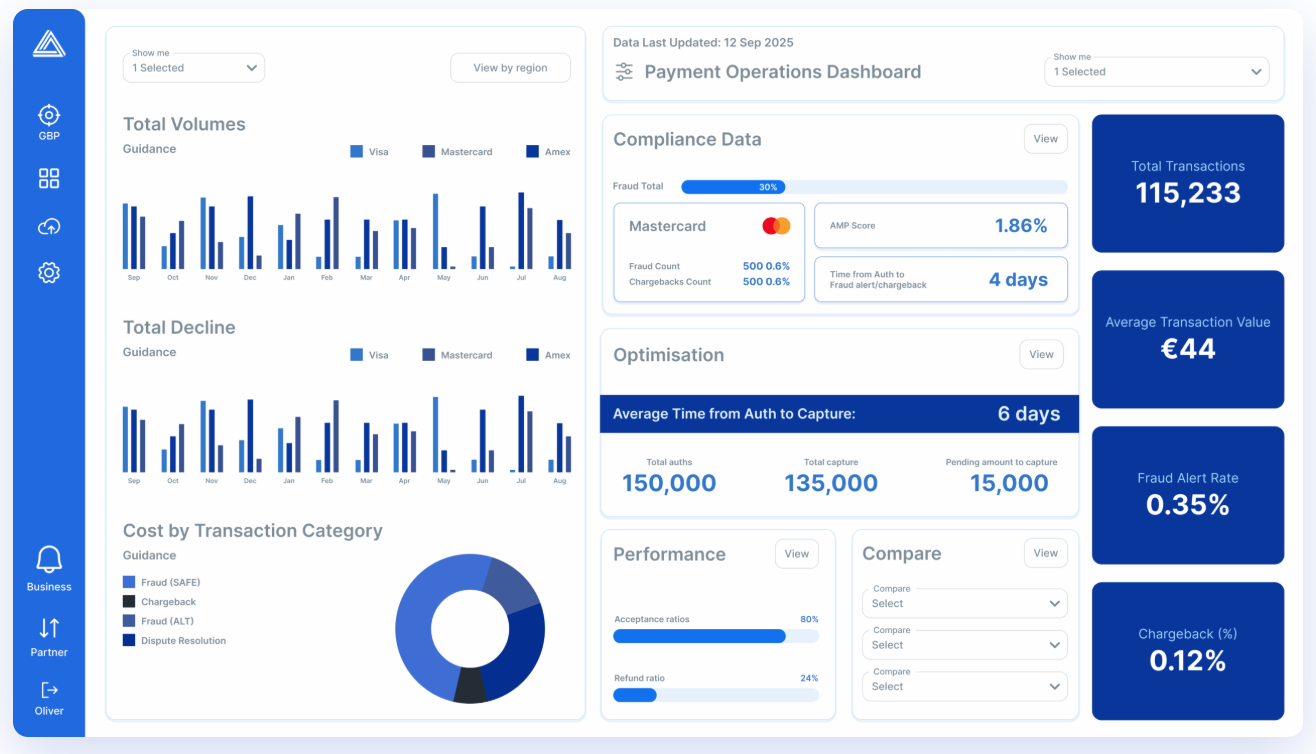
Unetix is a payments intelligence platform. We're creating the Chief Payments Officer as a platform.
Most mid-market businesses can't afford or justify a dedicated payments officer, but they absolutely need that function. Someone asking the hard questions, holding providers accountable, finding the inefficiencies, spotting the risks, identifying opportunities for a smarter payments set-up. For larger businesses, even those with internal tools or dedicated teams, it's about making sure the people in those roles have the right intelligence to make the right decisions and create a payments strategy fully aligned with the company goals. Either way, we're solving a challenge that's been ignored for too long.
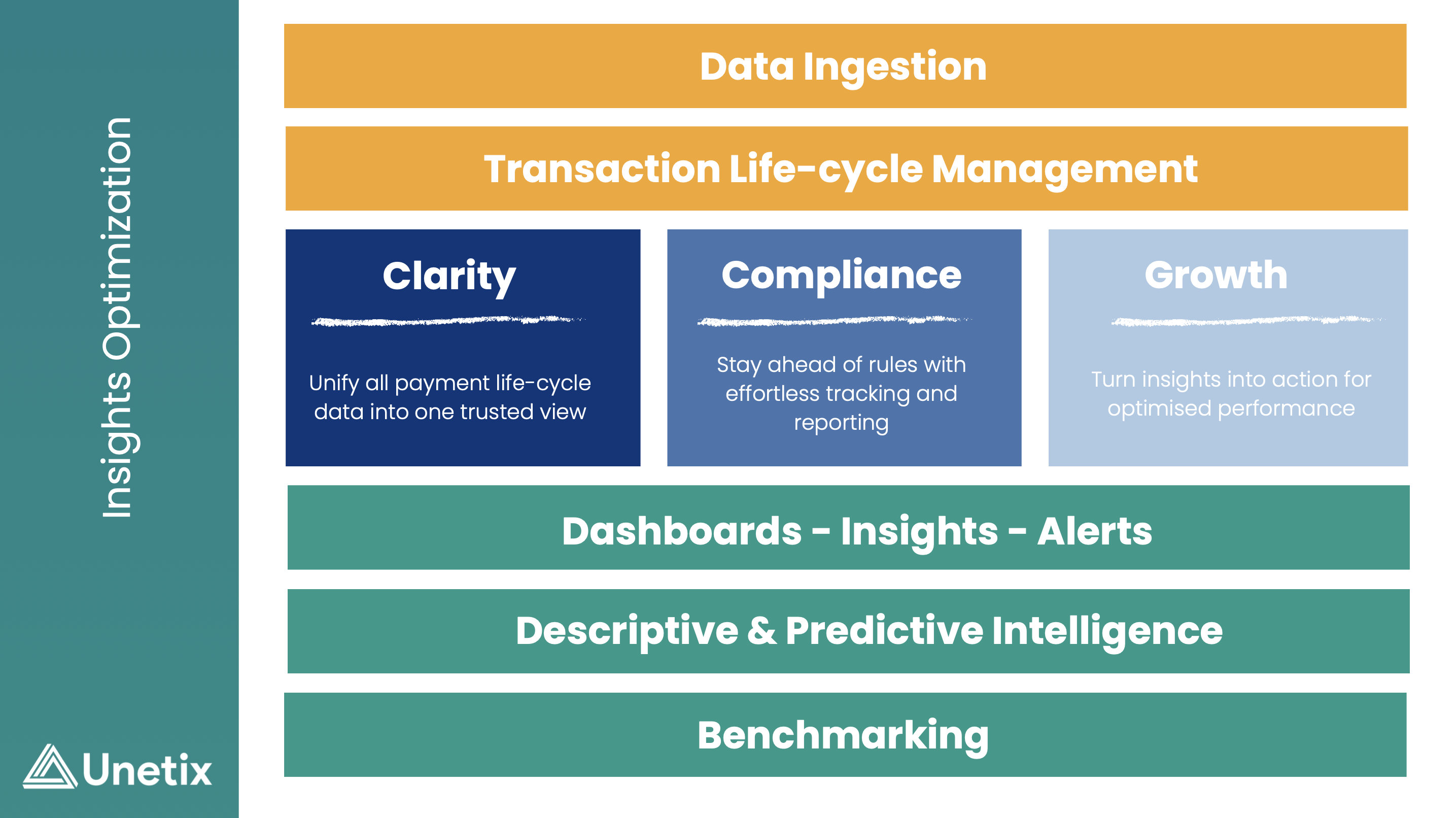
We're built around three pillars: Clarity, Compliance, and Growth. Clarity means you can finally see what's happening across your entire payment’s estate, a single normalised and rationalised that simplifies the complexity. Compliance means you've got the reporting and audit trails you need without the manual headaches, this creates the understanding of risks that accompany payment processing. Growth means we surface the insights that help you optimise costs, improve authorisation rates, allow you to scale your operations, enter new markets with confidence and make better decisions.
I wrote recently that we have more tools than ever but understand less than ever. The problem isn't a lack of technology. It's a lack of outcomes.
The merchants I speak to don't need more tools. They want more clarity. They need to know if their results are good or bad, and crucially, they need to understand why. A 2.3% decline rate means nothing in isolation. Is that strong performance or a warning sign? The answer depends entirely on context.
That's why Unetix delivers both sides of the picture. Internally, we give you complete visibility across your payment stack. Unified data from every acquirer and PSP, with the analysis to understand what's driving your performance. Externally, we benchmark your metrics against businesses like yours. Same vertical, same transaction profiles, same markets. So, when you see that 2.3% decline rate, you'll know whether you're outperforming the industry or leaving money on the table.
Merchants don't just need data. They need context. They need someone to cut through the noise and show them what matters, what's driving their results, and where the real opportunities lie. That's what Unetix is built to deliver.
There's rarely a single provider that does everything well for every market, every card scheme, every payment method. Merchants use multiple providers to optimise for authorisation rates in different regions, access local payment methods, manage risk, negotiate or set up for better pricing, or simply avoid putting all their eggs in one basket. It's smart strategy. Until you try to make sense of all the data.
A CFO told me recently that they added a fourth payment processor thinking it would solve problems. Instead, they just created four different versions of the truth. That's the reality for most businesses operating with multiple providers. They've added complexity without adding clarity.
Everywhere, honestly. At authorisation, you're trying to understand why approval rates differ between providers. At settlement, you're reconciling what was promised versus what landed in your account. At chargeback and dispute stage, you're chasing information across multiple portals. And throughout, you're dealing with different file formats, different field names, different reporting cycles, and varying levels of sophistication from each PSP. Some providers offer advanced retry logic and network tokenisation. Others give you the basics and little else. The complexity isn't in any single stage. It's in stitching the full picture together across all of them, while accounting for the fact that not every provider operates at the same level.
One payments director described their stack perfectly: a team where nobody speaks the same language. Stripe's data structure is completely different from Adyen's. Settlement timing varies. Currency handling differs. Transaction IDs don't match. You're not running a payment operation. You're running a translation service. And every time you want to answer a simple question, someone needs to spend a day reformatting data just to make a fair comparison.
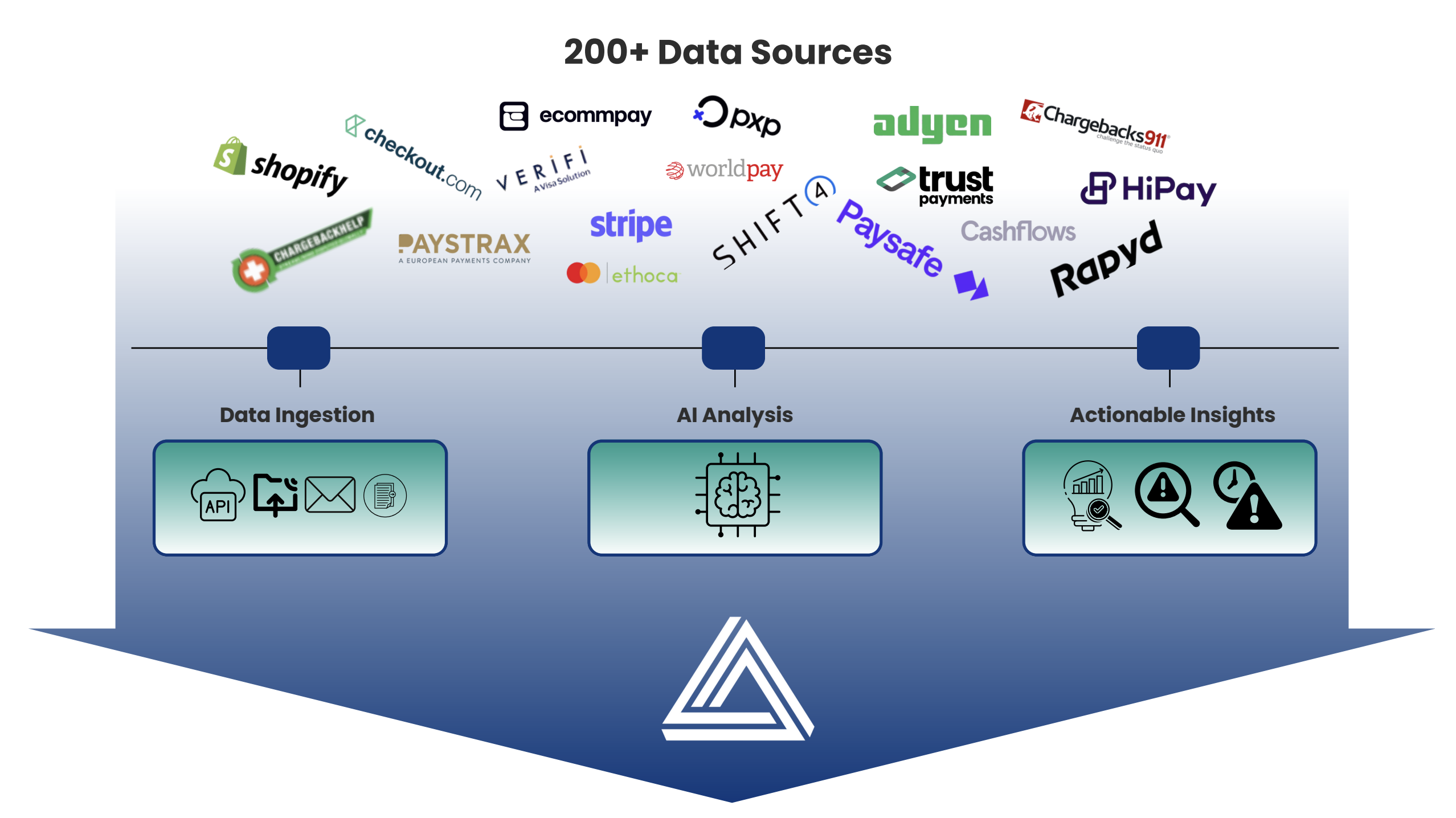
Unetix ingests data from all your payment providers and normalises it into a single, coherent view. No more logging into five different portals. No more manually wrangling spreadsheets to compare performance. No more guessing why your authorisation rate dropped last Tuesday. We give payment managers a unified dashboard where they can see everything in one place, with the analytics and alerting to do something about it.
More importantly, this frees up time. Time your payments team can invest in optimisations that make a difference. When your people aren't buried in data wrangling, they can focus on strategy. They can test routing rules, negotiate better rates, reduce declines. Unetix doesn't just give them tools. It gives them control, context, and the knowledge to grow their expertise. We want payment managers to become better at their jobs because of what they learn through the platform.
But it goes deeper than dashboards. Most businesses are stuck in what I call spreadsheet hell. Month-end reconciliation takes days. Finance teams export CSVs from multiple portals. Excel converts transaction IDs to scientific notation. When someone asks what your effective payment cost is, you laugh. Or cry. Or both.
We're helping businesses answer the really hard questions that keep payment leaders up at night:
Why are my authorisation rates different across providers, and what's causing it? Which provider is genuinely performing best for which card types and regions? Am I being overcharged, and where's the evidence to prove it? What happens to my business if my primary provider goes down tomorrow? Where are my biggest fraud and chargeback exposures, and are they getting better or worse? How do my costs and performance compare to similar businesses? What's the true cost of each transaction when you factor in everything? If I had £250,000 to invest in growth, where should I spend it to optimise growth of my business?
That last one is critical. Most merchants can't answer it confidently because they don't have end-to-end acceptance performance visibility. There's no point pouring marketing spend into a region where your subscription retention rates are under par or fraud and chargeback rates are quietly eroding your return. But without payment intelligence, you won't know that until it's too late.
A few big ones. First, payment orchestration is booming, which means more merchants are routing transactions across multiple providers and they need visibility into how that's performing. Orchestrators can help simplify front end transaction routing, but they're still leaving the end-to-end payments knowledge gap for merchants to figure out themselves. You might have streamlined the transaction flow, but you still don't have clarity on the why or the what next in the settlement and reconciliation process.
Second, there's increasing regulatory pressure around fee transparency and compliance reporting. Third, margins are tightening, so optimising costs and authorisation rates isn't a nice-to-have anymore. It's survival. And fourth, finance and payments teams are being asked to do more with less, so they need tools that save time, allow them to scale by removing manual tasks.
The lesson from 2025 wasn't that AI is coming. It's that the industry is more interested in talking about it than delivering anything useful. Most of what's out there is a productivity tool dressed up as an intelligence tool. We're building something different.
We've built five core focus areas: Payment Operations, Financial Performance, Optimisation, Compliance, and Comparison and Benchmarking. What makes us unique is that we're provider-agnostic and merchant-centric. We're not selling you acquiring services. We're giving you the tools to hold your providers accountable and make better decisions. We're focused on giving merchants complete visibility across the transaction lifecycle, from authorisation through to disputes and chargebacks.
I like to think about payment strategy across three dimensions, and we've built Unetix to support all of them.
First is Expansion. How do you expand into new markets with cross border sales or offer more payment methods in different regions? How do you optimise the offerings you have to drive revenue or growth? Are there places where you can renegotiate or avoid costs? You can't answer those questions without visibility.
Second is Protection. How do you protect your business? Do you have the right payment redundancies in place? What are your biggest risks and how do you address them? Most businesses don't know until something breaks.
Third is Scalability. With what you're offering today, how do you set yourself up to support growth? Is it more automation? Is it revamping the infrastructure of your offering? You need to understand where you are before you can plan where you're going.
The difference between traditional reporting and payment intelligence is simple. Traditional dashboards show you what happened. Payment intelligence shows you what it means and what to do about it. It's the difference between a spreadsheet and a solution acting as your strategic adviser.
''We're built around three pillars: Clarity, Compliance, and Growth.''
- Nick Dobson, CEO and Co-founder of Unetix
Time back in their day, for starters. No more manual data gathering and spreadsheet wrangling. Beyond that: better visibility into what's happening, faster identification of problems that restrict growth, clearer evidence when negotiating with providers, and the confidence that comes from having accurate, unified data. It's the difference between guessing and knowing.
We've seen businesses spending €250,000 annually on payment operations where only €40,000 was processing fees. The rest was hidden labour that never showed up as a line item. Manual reconciliation time. Error correction costs. Opportunity cost of your best finance people doing repetitive work instead of strategic analysis. Tool sprawl from paying for multiple analytics tools because none of them see the full picture. Delayed decision-making from not acting fast enough on what the data's telling you.
Unetix eliminates those hidden costs.
Payments teams are the obvious first answer, but it goes beyond that. Finance benefits from cleaner visibility and fee analysis. Compliance and risk teams get audit-ready reporting. Even operations and customer service benefit when they can quickly trace a transaction across its full journey. We're breaking down silos, not creating new ones.
We work with merchants of all sizes. For smaller businesses with no dedicated payments resource, we're the Chief Payments Officer they can't afford to hire but desperately need. For larger enterprises with internal tools and dedicated teams, we're the intelligence layer that ensures those teams have the right data to make the right decisions.
The pain is universal. I've spoken to founders running 5,000 transactions a month drowning in spreadsheets. I've spoken to enterprise teams processing millions of transactions who still can't answer basic questions without a lot of manual work. A founder of an eCommerce business told me recently that at 5,000 transactions spreadsheets worked. At 50,000 they hired more people. At 500,000 they realised they can't hire their way out of this.
Vertically, we're seeing strong fit with e-commerce, travel, remittance business and any business with cross-border complexity. But honestly, if you're working with multiple payment providers, you've got this problem.
Geographically, we're EU & UK focused to start, but we're already seeing interest globally, including from the US. The problem doesn't respect borders. Every merchant with multiple providers has the same challenge regardless of where they're based. Payment complexity is a global issue, and the need for intelligence over infrastructure is universal.
Our focus is proving value with our customers. Beyond that, we'll be expanding our integrations, adding benchmarking capabilities so merchants can see how they compare to peers, building out reconciliation and settlement intelligence, and developing more predictive analytics.
The future of payment intelligence is moving from reactive to predictive. Instead of asking why my acceptance rate dropped last week, you'll be asking what's likely to impact my performance next month, and what should I do now to prevent it. We're heading towards autonomous optimisation. Payment intelligence that doesn't just tell you what to do but does it for you in real time.
The vision is to become the intelligence layer that sits across every merchant's payments estate.

.jpg)


.png)
.png)