

For two decades, the dominant logic of enterprise payments was consolidation. Pick a strong primary PSP, integrate deeply, and let the relationship compound.
That logic is breaking. Only 19% of enterprise merchants still run a single PSP, and more than 80% have moved beyond, or are actively moving beyond, the single-provider model.
However, our first Merchants Pulse research found something that complicates the picture. 84% of merchants are considering adding or switching a provider within 24 months, but very few of them will. Integration complexity, internal resourcing and business disruption risk form a wall of operational friction that keeps merchants tethered to providers they would otherwise replace.
The second report in the series looks at what that addition produces. Orchestration, multi-acquiring, tokenisation, routing, reconciliation: a stack assembled one layer at a time, each justified on its own terms, none designed as a whole.
The headline numbers are what you would expect. Two thirds of merchants have orchestration live or committed. Roughly three quarters are on the same path for multi-acquiring. On paper, this is a market that has solved for optionality.
The implementation data tells a more careful story.
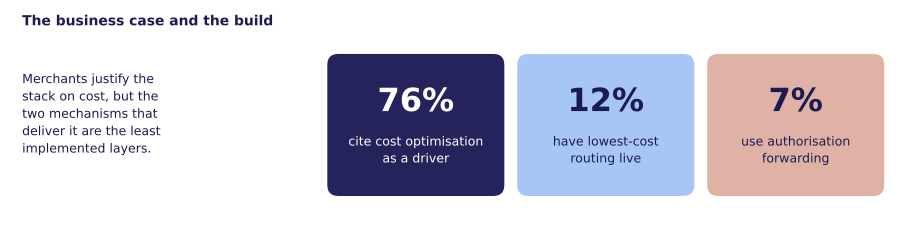
Merchants overwhelmingly say they build a multi-provider stack for cost optimisation. Very few have switched on the mechanism that delivers that. The gap between the business case and the build is the single most striking finding in the report, and it means a large share of enterprise merchants are carrying the complexity of a portfolio without collecting the return.
There is a quieter problem underneath.
Merchants told us that migration difficulty is what stops them acting on switching intent. Yet the majority are, through ordinary day-to-day architecture decisions, making that difficulty worse. The credential layer is where diversification quietly stops, and most organisations have not looked at it closely.
"The biggest misconception is that the hard part is getting a new provider live. In reality, the true work lies in managing the transition from one provider to another while ensuring customers never notice the change." Laura Treude, Director of Group Payments at an international retailer.
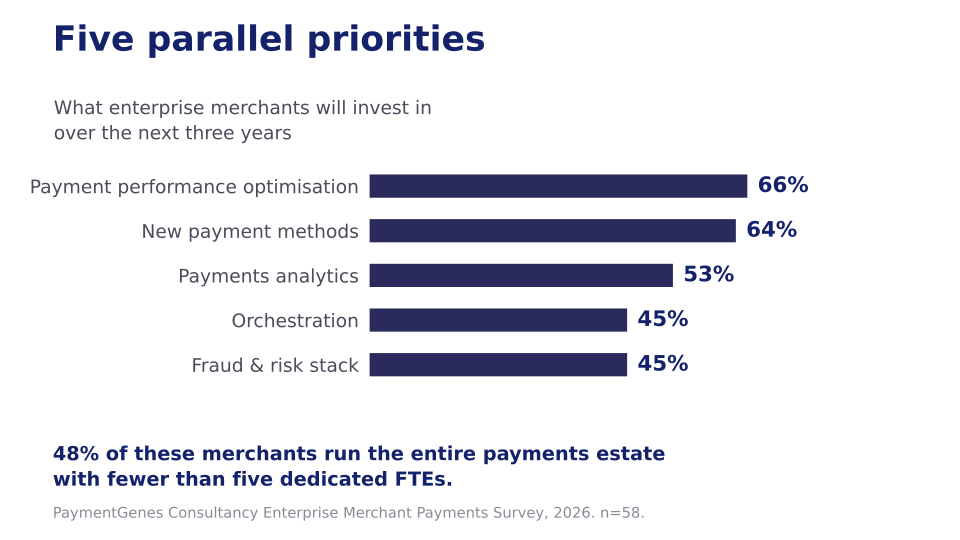
Nearly half of enterprise merchants run their entire payments estate with fewer than five dedicated people. Against that sits a three-year investment agenda of five parallel priorities, each of which becomes an operating requirement the day it goes live.
The technology is available to everyone. What separates merchants now is whether they can run what they have bought. The payments team’s ability to execute on the technology and to activate other company departments becomes a differentiator.
Merchants Are Going Shopping covers adoption across all seven layers of the payments stack, the gap between what merchants say drives their architecture and what they have actually built, where method proliferation is costing more than it returns, and what each finding means for merchants, acquirers and orchestration providers.
Get a benchmark read on your own PSP setup.
.jpg)
Get a benchmark read on your own PSP setup.



.png)
.png)