Most discussions on agentic commerce focus on the transaction layer: which protocol prevails, who authorises payment, and where checkout occurs. Yet the more fundamental question comes earlier. Before an AI agent can transact, it must identify, evaluate, and select a product from countless alternatives. That decision depends entirely on the quality and structure of the merchant's product data.
This upstream product context layer remains largely overlooked. Connectivity to AI agents is rapidly becoming ubiquitous across major platforms, often by default. However, being discoverable by AI is not the same as being understandable. The gap between technical connectivity and AI readiness is where a significant share of future e-commerce volume will be won or lost.
To explore what it takes to close that gap, we spoke with Zhao Hanbo, Co-founder of Nile, which builds the product context layer that enables AI agents to accurately interpret and evaluate merchant catalogues.
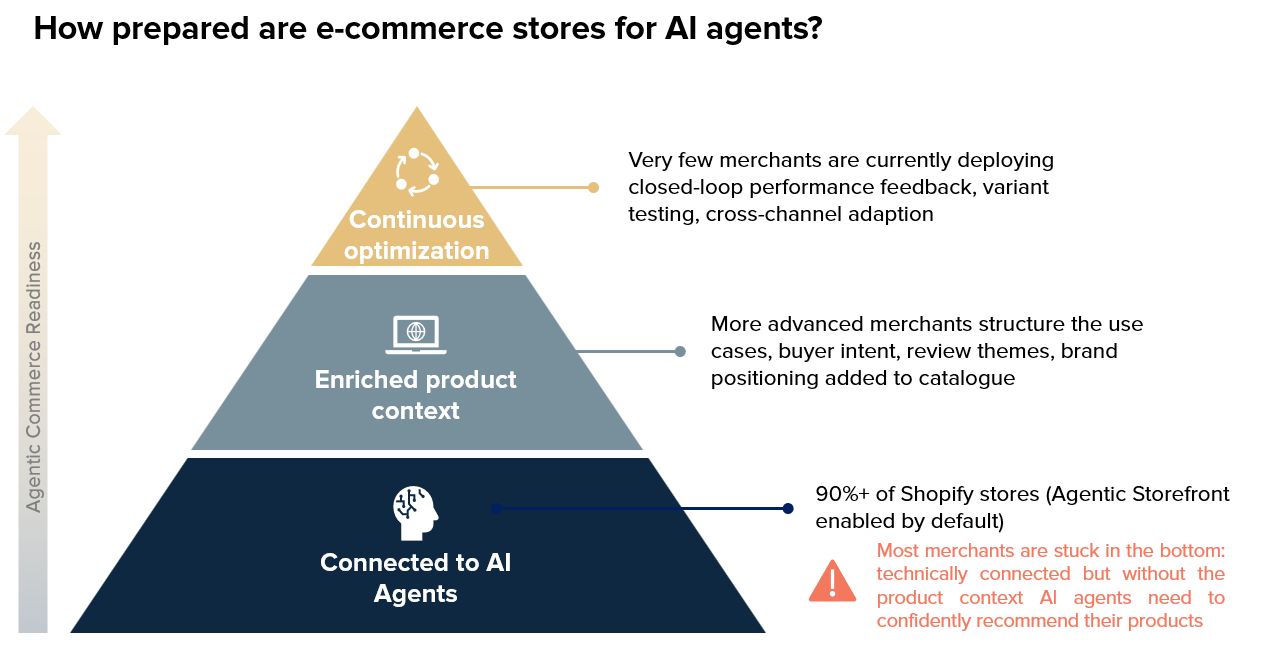
It depends on how you define "prepared."
In the loosest sense, over 90% of Shopify stores are technically connected to AI agents today. Shopify's Agentic Storefront is enabled by default, and very few merchants actively opt out. Given that Shopify powers roughly 29% of the US e-commerce platform market and around 10% globally across 4.6 million+ active stores, that's a significant base of merchants whose products are already accessible to AI agents through protocols like ACP and UCP.
But connectivity is not the same as readiness. It's like listing your products on Amazon: the listing exists, but that doesn't mean you've optimised for the channel.
The real challenge is product context. AI agents don't just retrieve products by keyword. They evaluate whether a product is a strong match for a specific buyer's needs. Traditional product feeds were designed for Google Shopping and website display. They answer "what is this product?" but not "why should I recommend it for this particular buyer?"
Merchants who wait until AI channels are visibly large in their analytics will likely find their competitors have already established strong positions.
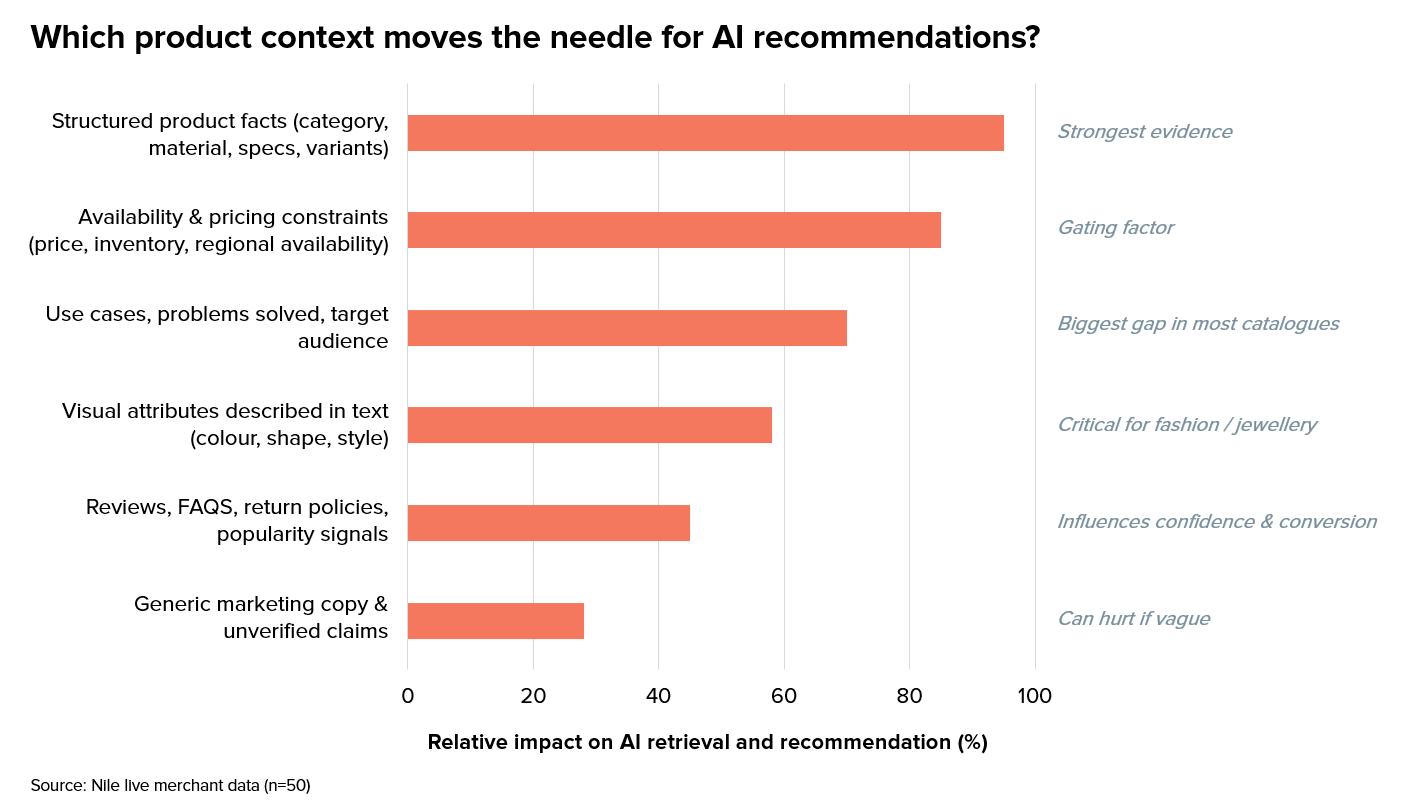
Our core finding from running experiments across dozens of merchants: context is not a "more is better" game. What determines impact is whether the context is factual (verifiably correct), accessible to the platform (meaning AI agents can actually read and index it), and aligned with real buyer questions.
Here is how we rank the types of product context by impact, based on our experiments:
"In some of our tests, adding vague marketing language actually diluted the signal and made retrieval results worse. AI rewards specificity and factual precision, not persuasive copy."
One finding that surprised us: the gap between what traditional Google Shopping feeds require and what AI agents actually use is much larger than most merchants realize. Content types like product FAQs, user manuals, ingredient guides, related-product relationships, popularity signals, complete variant options, and review summaries barely matter for Google Shopping but are highly impactful for AI agents like ChatGPT and Gemini. The upstream data requirements for agentic transactions are fundamentally different from traditional e-commerce.
What determines success is less about the vertical name and more about two factors: (1) how explicit and structured the product attributes are, and (2) how narrow the buyer's intent is for a given query.
Problem-solving products with clear specifications perform best. Men's grooming is a strong example: buyers naturally search by body part + problem + product type (e.g. "anti-chafing cream for thighs"). The intent is narrow, and the attributes are structured.
On performance: across our merchant base, AI-attributed traffic converts at rates that are competitive with and often exceed overall store conversion. Most merchants see Nile-attributed conversion rates 2-4x above their store average.
Top-performing merchants see AI-attributed revenue reaching 2-3% of total store revenue, with the channel growing month over month.
Traditional feed management tools like Channable, DataFeedWatch, or Feedonomics help merchants format, optimise, and distribute product feeds to channels like Google Shopping and Meta. An agentic catalogue differs across three fundamental dimensions:
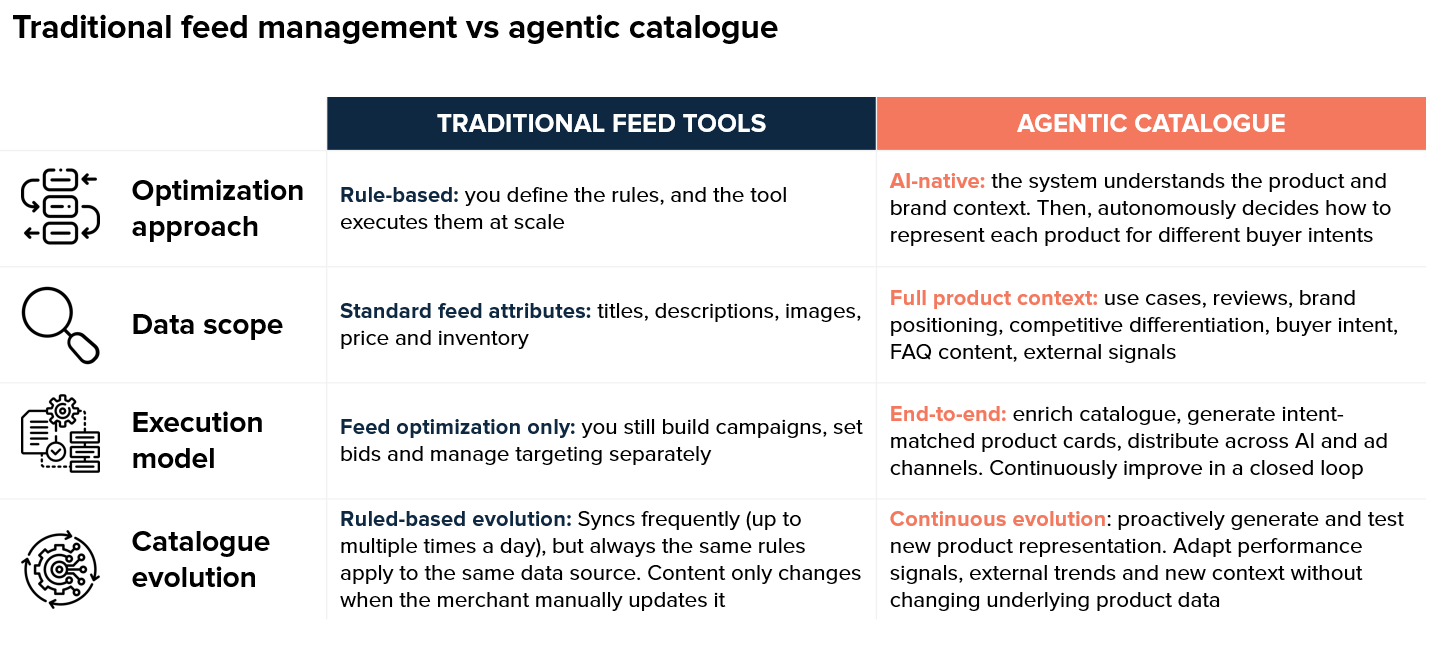
Why this matters for the payments ecosystem: an actively optimised catalogue means more products get recommended by AI agents, more recommendations convert, and more transactions reach the payment rails. A feed that is "technically up to date" still leaves most of the AI commerce opportunity on the table. The upstream product context layer directly determines the volume and quality of downstream transactions.
"A feed that is 'technically up to date' still leaves most of the AI commerce opportunity on the table. The upstream product context layer directly determines the volume and quality of downstream transactions."
Product context sits upstream of the transaction. AI agents can only recommend what they can actually understand, and most catalogues today are written for a human browsing a website, not for a system trying to match a specific need. That gap is fixable, and right now it's still cheap to fix, which makes it a payments problem, not just a merchandising one.
Product context is becoming media infrastructure. Feed-based ad formats already run on structured product data, and AI-native formats like ChatGPT Ads add new inputs such as "context hints." The same context layer that powers AI shopping discovery also powers paid placement. When organic and paid both draw on the same upstream data, total AI-mediated transaction volume scales faster than either channel alone.
The next 12 to 18 months. Expect three shifts. More AI platforms will launch native shopping and ads. Merchant demand will move from interesting experiment to operational priority as AI-attributed orders grow. And the line between organic AI discovery and paid AI placement will blur, the way SEO and SEM converged. For payment providers, the practical read is simple. Transaction volume will increasingly depend on upstream catalogue quality, and merchants who are not ready just get skipped.
Nile's mission is to help e-commerce brands win in agentic commerce without adding operational complexity. The platform transforms a merchant's product catalogue and surrounding context into an AI-native catalogue that powers discovery across AI assistants (ChatGPT, Perplexity, Gemini), feed-based and AI-native ads (Google PMax, Meta Advantage+, ChatGPT Ads). By generating intent-matched product cards and continuously optimising through closed-loop performance signals, Nile enables merchants to maximise revenue from AI channels on full autopilot. Backed by top VCs, the team combines veterans from Amazon, Supermetrics, and leading AI research with deep e-commerce and martech expertise. Learn more at nile.app.


.png)
New survey data from 58 enterprise merchants on payment orchestration, multi-acquiring and tokenisation adoption, and why the layers that deliver cost savings are the least implemented.


.png)