Most of the debate on agentic commerce has focused on merchants: how to be found by AI agents, how to keep customer ownership, which protocols to support. Issuers have received less attention. For now, that is partly justified. Most agent-driven purchases still end with a person confirming the payment, so the issuing side sees little change.
That will not last. As agents move from recommending products to completing transactions on their own, the impact shifts to the parts of the payment chain that issuers control: authentication and authorisation.
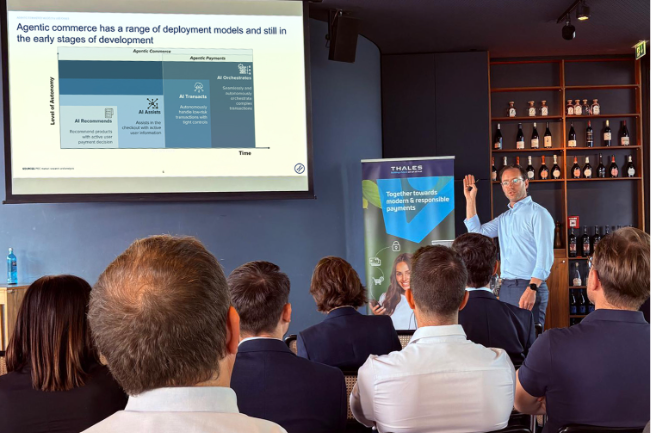
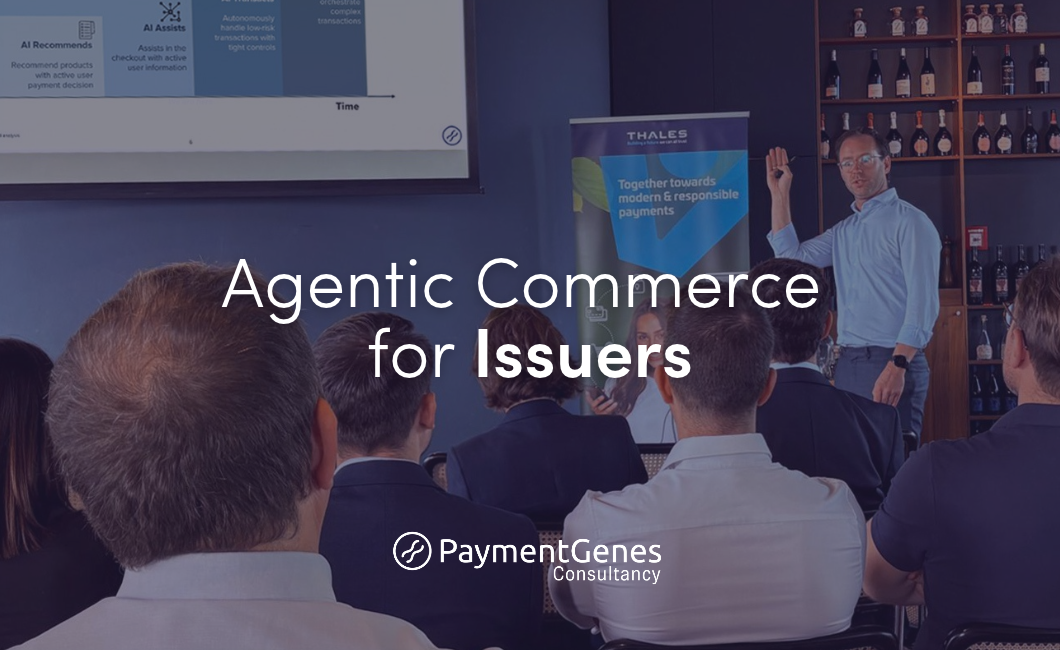
This was the focus of Bas van Donselaar's keynote, Agentic Commerce: Strategic Perspectives for Issuers, at the PAYment trends with Thales 2026 in Frankfurt on 29 September. The event centred on innovation in card issuing, from API-driven processing and token assurance to card design and European data resilience.
Speakers confirmed the starting point. In Europe, agentic payments still depend on a person in the loop, and issuers can rely on issuing processors and the schemes for much of the early work. Bas’s session looked at what changes for trust and authorisation once the party initiating a payment is no longer a person. This article builds on that presentation and on our earlier research.
Access all the event presentations here.
In traditional e-commerce, a consumer looking for new headphones moves through several steps: an online search, browsing websites, comparing products and reviews, and finally checkout. In an agentic journey, the consumer gives an AI agent one instruction. The agent searches, compares and finds the best deal within seconds, then adds the item to a basket or completes the purchase inside the AI interface.
We described this compression in The Rise of Agentic Commerce: How AI Will Reshape Merchant Strategy. For issuers, the key point is where the friction disappears. A decade of e-commerce innovation focused on checkout: one-click payments, tokenised cards, biometric authentication. Agentic commerce removes friction earlier, in discovery and basket assembly. Checkout is the last step to change, and it is the step issuers care about most.
We map agentic commerce on four levels, each giving the agent more control than the last:
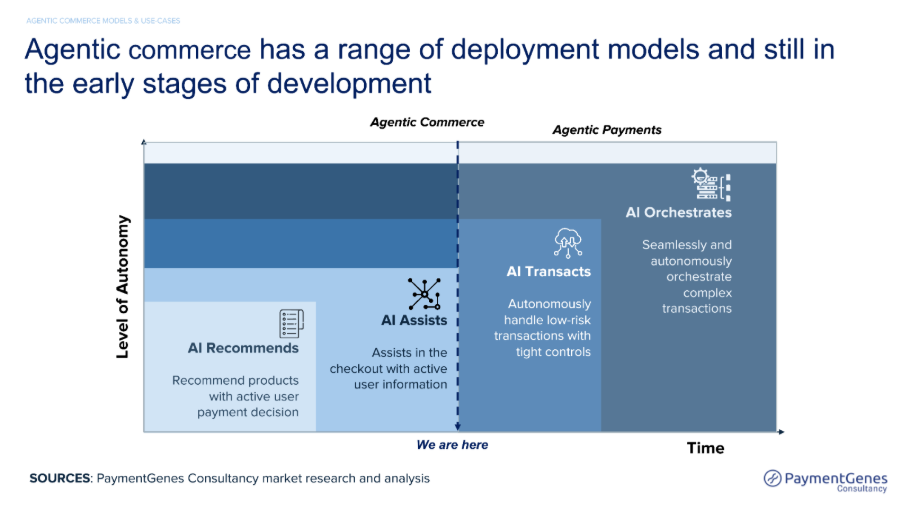
The first two levels are agentic commerce. The last two are agentic payments, where the agent initiates the payment itself. The market today sits at the lower end. Live deployments are mostly discovery and assisted checkout with a human in the loop, such as Instacart's flow in ChatGPT, where an agent selects products, builds a grocery list and completes the purchase.
Moving up the scale reduces friction, but it also reduces customer proximity. Each level hands more of the relationship to the agent.
"Today almost every agentic purchase still ends with a person confirming the payment. The question for issuers is not whether that changes, but how they will recognise and authorise a payment when it does."
Use cases already extend well beyond consumer retail. Travel planning and booking assistants, automated B2B procurement and corporate travel agents are live or in pilot alongside retail product discovery. Our market estimate puts agentic commerce at around 6% of US sales by 2030, from a near-zero base in 2025.
Consumer behaviour supports that direction, with limits. In McKinsey's Consumer AI Discovery Survey (December 2025), European consumers used generative AI mostly in the early stages of shopping: 63% for comparing options, 55% for learning about products and 46% for discovering new brands. Use falls in later stages, to 21% for repurchasing and replenishment.
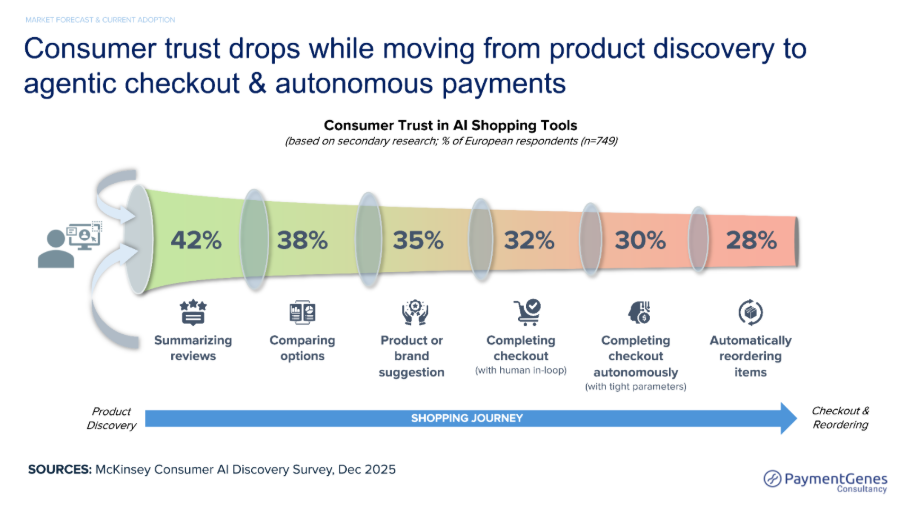
Trust follows the same curve. In the same survey, 42% of European respondents trust AI to summarise reviews, but only 30% trust it to complete a checkout autonomously within set parameters, and 28% to reorder items automatically. The closer the agent gets to the payment, the less consumers trust it.
This gap is where issuers hold an advantage. A 2025 Visa study, Earning consumer trust in the age of agentic commerce, asked consumers in the US, Australia and New Zealand which companies they would be comfortable using for a new AI shopping service. Payment brands such as PayPal and Visa ranked among the most trusted, ahead of most AI platforms.
Agentic payments will only scale if consumers trust an agent to spend on their behalf, and that trust is closely tied to the payment credential behind it. For issuers, this is a strategic position.
"Consumers already trust payment brands more than most AI platforms to act for them. Issuers should treat that trust as a position to build on, not something they can take for granted."
Across the payment chain (initiation, authentication, authorisation, settlement), the impact of agentic commerce depends on the level of autonomy. When the AI recommends or assists, a person remains in the loop and issuer processes continue as usual. The first changes land with merchants and PSPs, which need agent-ready catalogues, checkout flows and fraud setups.
When the AI transacts or orchestrates, issuers are directly affected. Authentication and authorisation must answer a new question: is this payment unauthenticated, delegated by the cardholder, or authenticated by the agent itself? Existing fraud models were built to separate people from bots. In agentic payments, a legitimate transaction may come from a machine.
The industry is responding. As covered in Who holds the key to the future of commerce orchestration?, Visa's Trusted Agent Protocol, Mastercard Agent Pay and Google's AP2 focus on agent identification, intent verification and secure payment authorisation. These frameworks give issuers more information at the moment of authorisation, but they are still being defined, and many compete rather than complement each other.
In Frankfurt, Visa outlined how this is taking shape in Europe. SCA is used to initiate the transaction and assigns a passkey to the agent, and the agent is flagged in the transaction data. The Trusted Agent Protocol then lets merchants distinguish trusted agents from malicious bots.
Thales added a signal on the issuer side. Its unified credential foundation assigns a Token Assurance Level (TAL), indicating how much an issuer can trust a token. The highest level combines a token with device binding and a passkey. As more transactions are initiated by agents, signals like these become central to the issuer’s risk assessment. The infrastructure behind them matters too: Thales's D1 platform replaces batch processing with fully API-driven, instant and traceable issuing processes, so issuers can modernise step by step.
Agentic payments are developing faster in the US, largely because it has no strong customer authentication requirement comparable to Europe's. Volker Koppe of Visa, reviewing a year of progress in agentic commerce at the Frankfurt event, confirmed that human-in-the-loop remains the main model in the EU because of SCA. In Europe, SCA under PSD2 adds a step that autonomous flows must accommodate. That slows adoption, but it also gives European issuers time to prepare before volumes grow.
"Strong customer authentication means Europe will move more slowly than the US. That gives issuers time, and those who use it to prepare will be better placed when adoption accelerates."
Agentic commerce is still at an early stage, and attributable payment volumes remain limited. For issuers, this makes it a period for preparation rather than reaction. Three priorities stand out:
For the merchant side of this shift, see Agentic Commerce: Opportunity or Disruption for Merchants?
PaymentGenes Consultancy supports issuers, PSPs and merchants in assessing what agentic commerce means for their strategy, products and payment flows. To discuss your position, contact our team.

PaymentGenes Consultancy supports issuers, PSPs and merchants in assessing what agentic commerce means for their strategy, products and payment flows. To discuss your position, contact our team.